

OLIVIA KEMP
An Allegory of Motherhood (central panel)
Tinta sobre papel
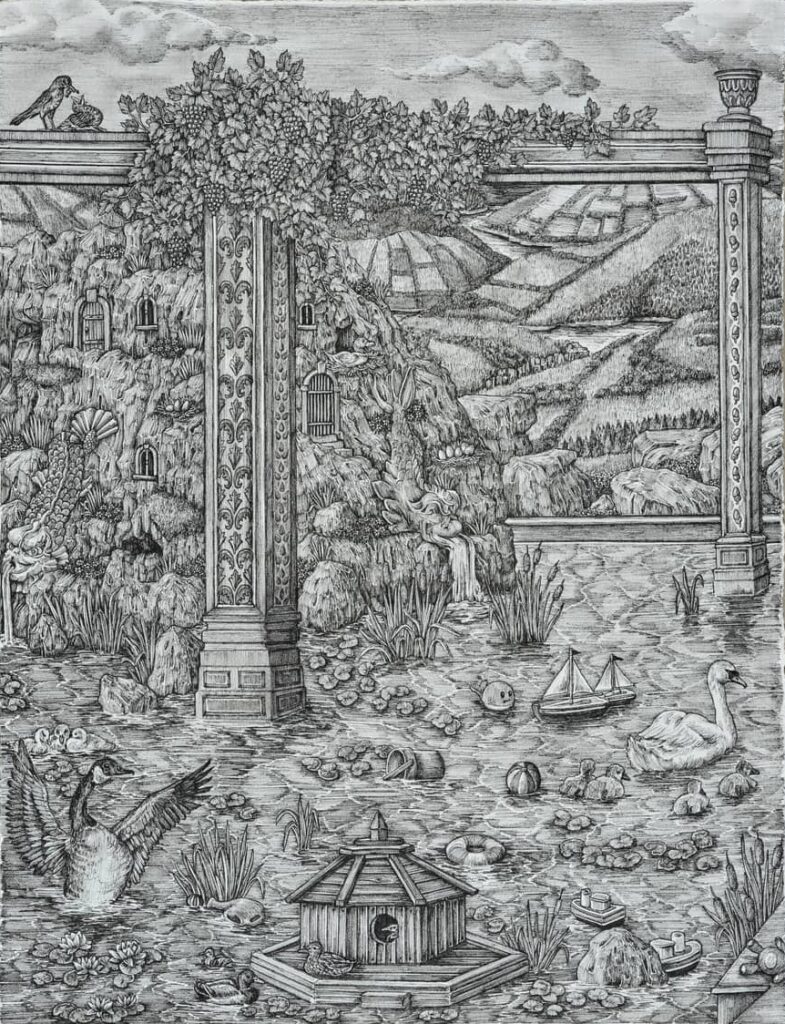
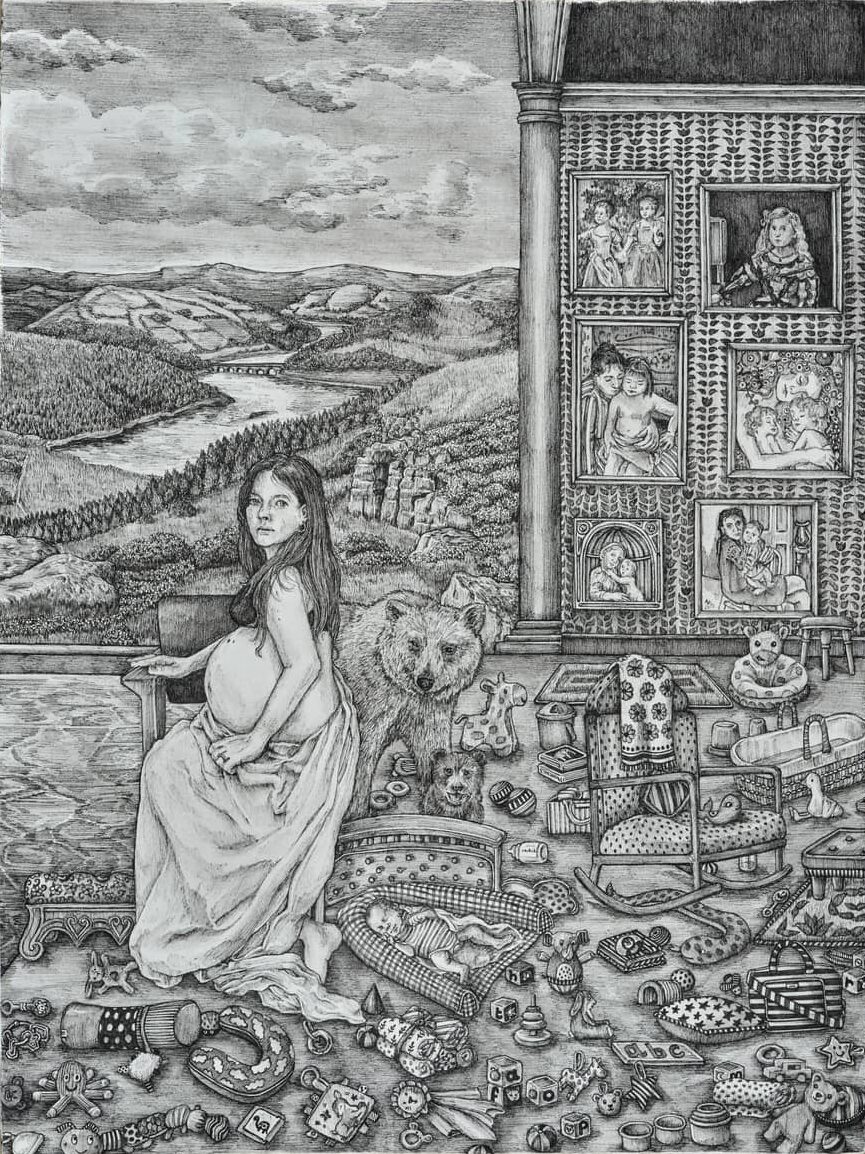
375 × 290 mmCentral panel of the triptych An Allegory of Motherhood: "An Allegory of Motherhood is conceived as a triptych which, due to its format, is reminiscent of 15th-century Flemish works, with a central panel larger than the two side panels flanking it (...) In the central panel, like a secular Madonna of the 21st century, the artist poses in an advanced state of pregnancy. She shares the same landscape background with the birds in the left panel, but in her case a wall has been added on which six paintings hang, all showing girls or mothers with their children. Among the former are a version of Gainsborough's Daughters Chasing a Butterfly (London, The National Gallery of Art, 1756) and Velázquez's Infanta Margarita (Paris, Musée du Louvre, ca. 1653), depicting the daughter of Philip IV and Mariana of Austria. Gustav Klimt's The Three Ages of Woman (Rome, Galleria Nazionale d'Arte Moderna, 1905) is included in the version circulating on the internet and not in the original. It is a modified version – not innocently – to remove the older woman who appears on the left in the original and introduce a second child – thus turning the mother in Klimt's work into the mother of twins – who covers the woman's bare breast. Here, the artist draws on classical imagery associated with motherhood, both traditional and more recent interpretations, which she uses to draw attention to the gender-biased exclusions in Art history. Kemp has painted herself in close-up, as a counterpart to the panel depicting the Virgin and Child hanging on the lower left of the wall. A mother bear and her cub are positioned behind the chair on which she is seated; in Marian imagery this would be a throne, and where here we see bears, there we would be angels accompanying or carrying the Virgin's throne. The artist is not holding her baby in her arms, but rather he is depicted at her feet, sleeping peacefully in her cot. Both are surrounded by a large number of objects related to childcare and children's games: rattles, stuffed toys and plastic books designed to allow their young owners to become familiar with the sensation of holding a book in their hands. In the background on the right, there is an empty rocking chair with a blanket and a bassinet; both are usually occupied by mother and child, who have left them behind to pose." (Text taken from the exhibition catalog: María Cruz de Carlos Varona)
This work belongs to the exhibition LINEA NIGRA.